
First posted 27th May 2016
I spent the early May Bank Holiday weekend in Hospital wired up to an ECG machine with my heart rhythm being monitored. On the Friday I had experienced a severe arrhythmia.
Whilst stays in Hospital and trips to A&E in particular, are always exciting and (in retrospect admittedly) entertaining – more on that in a future post – this was a bit of an upset as I was hoping the Cardiac Ablation I had undergone six months previously would have resolved things for a bit longer.
I had my first arrhythmia in my mid-teens; I think when I was fifteen, but my memory gets a little blurred now. What I do remember is waking up in the middle of the night with my heart pounding. Looking back, I suspect it was doing 150 to 200 beats a minute. That’s a lot, considering my resting heart-rate is around 70-75 beats per minute.
Not knowing what to do I lay in the dark for a while somewhat worried, before waking up my mother. I don’t remember doing anything to stop it – there was no ambulance called and after a while (probably an hour or two, going by subsequent occurrences) it stopped and my rhythm returned to normal.
Overall, as I recall, my response was to worry during the arrhythmia, then pretty much forget about it, once it had passed and no harm seemed done. It was probably mentioned to the consultant the next time we saw her. How times change!
My heart rhythm has always been… interesting. It’s pretty irregular with ectopic beats thrown in every now and again in for a bit of variety. One GP has described it as going two beats, a pause then two quick beats, as it tries to catch up.
Additionally, if you listen carefully (ideally with a stethoscope) you can hear a swooshing sound in the beat which is, I believe, the blood moving between the ventricles through the hole in my heart. At best, my rhythm has more of a jazz feel to it than a steady marching band beat. I often suspect this is the reason for my:
- Dancing skills (mostly flailing and stumbling with occasional pauses to get my breath back),
- Musical ability (it took me three years to complete the first year book for the violin – though that may have been, in part, due my lack of diligence at practicing!)
- Complete inability to clap along in time! I’ll start of in sync with other people and then sort of, drift…
Unfortunately, I don’t think I can blame my singing voice on it.
To continue with the jazz metaphor, there’s also the improvised solos. Occasionally (not like every day though, or even every week) my heart will do a little run of rapid beats known as tachycardia, which I feel as palpitations, . If these runs are the short refrains, what I experienced on the Bank Holiday was a extended solo.
There are all sorts of arrhythmia, with different names describing the nature of the rhythm and the areas of the heart affected. Some of the more common ones are entertainingly demonstrated in this video… https://www.youtube.com/embed/EqUfgffJx_8
I have, until recently, tended to suffer from attacks of Supra Ventricular Tachycardia, with the prolonged, rapid heartbeat described earlier as happened during my first attack. Every few years I would have one – and aside from the slight discomfort, there never seemed to be any harm from them. Invariably as soon as I went near a medical professional, the attack would end and I’d feel guilty for bothering them. I’d dutifully report the incident next time I was at the Royal Brompton, and then carry on. After one incident I was given a 24 Hour ECG and an episode of some sort was recorded. I was given some beta-blockers to regulate my rhythm, the Tachycardia were much reduced and all seemed well.
In the last couple of years, I experienced more frequent arrhythmias (Including one in the Antarctic, which got me confined to inside the ship – another story for another time). When I discussed them with the Cardiologist it provoked a somewhat more worrying reaction than on previous occasions. It turns out that the “no harm seemed done” attitude I had been taking was somewhere between lackadaisical and downright dangerous.
For most people, an arrhythmia of the sort I tend to experience is only a danger if they continue for a long while (and I believe we’re talking days here) as the heart gets exhausted from maintaining the rapid beat. Needless to say, for myself it’s a little more complicated.
First off, there’s the pressure. My blood pressure is low because of the various medications I’m on, but in certain arrhythmia the blood pressure can drop as the rapid beating means the chambers do not fill properly before they being emptied out. Most people’s bodies can deal with the reduced pressure and loss of efficiency that causes, but mine is at more risk. In one attack last year, after 2 hours I was grey and exhausted. A few months later I was in a similar position after about 10 minutes. A drop in blood pressure can also lead to dizziness, fainting, and blacking out – fortunately I’ve never experienced those.
Additionally, because of the non-standard blood flow in my heart, there are areas of little or no movement I’m in more danger of blood clots forming. In an arrhythmia the changing patterns of blood flow could result in a clot escaping and travelling round the body, potentially causing an embolism (Very not good).
So my instructions changed – no longer was I to sit and wait for the episode to finish of its own accord. If I experienced an arrhythmia that didn’t self-terminate in around 15 minutes, I was to call an ambulance and go to A&E with all haste.
The reason for this is that I was told that if I experienced a long lasting arrhythmia (more than a few hours), with my underlying condition it could prove lethal. They even put it in a letter for me.
Instructions like that give one pause for thought. I subsequently received further instructions from my local hospital, that I am not go to A&E, but rather phone ahead and go directly to the C.M.U. I’d only have to be transferred there anyway, and the time lost going to A&E could be vital. Fortunately, I’ve not had to use this system yet though the “Oh Crap!” letters (as they are colloquially called) have been used a couple of times causing outbreaks of consternation in Doctors who were unlucky enough to be shown them!
So, having had a certain level of concern instilled, and the attacks being more frequent, surgical treatment became a priority and, after an episode resulting in good ECG data, possible.
So what is there that can be done about arrhythmia? Well it would seem there are several paths that can be taken.
The first path is what you might call immediate treatment, to stop an episode that’s in progress. There’s easy stuff I can try at home such as sitting quietly (I’m not doing a glossary entry for that one!), Eating Ice cubes or the Valsalva Manoeuvre.
Once the ‘home treatments’ are exhausted it’s off to Hospital for Cardioversion. I’ve heard one description of drug based cardioversion from a friend who told me:
“They gave me an injection of something that would – and this is a direct quote – ‘give me a feeling of impending doom’. It stopped my heart for a few seconds and then it was right as rain. Amazing stuff.”
I have to say, it’s got close, but I’m very glad I’ve never been on the receiving end.
A longer term response to the problem can be through drugs. A class of drugs called Beta-blockers in particular are used to give a more regular heartbeat. They reduce blood pressure, so I think my doctors are reluctant to increase the dose too far for me. There are other drugs too, but I’ve not experienced them and they have their own drawbacks.
The final approach (That I’m aware of) is through surgery such as a Cardiac Ablation, which destroys the malfunctioning nerves causing the arrhythmia, or the fitting of a pacemaker, which intervenes automatically to maintain the heart’s rhythm. I’ve had a Cardiac Ablation but I hope I’m some way off needing a pacemaker.
I suppose the real questions though are: “what’s it like?” and “How does it affect you and those around you?”.
I’ll start answering those by talking about the episodes themselves. I’ve fortunately avoided the fainting and dizziness, and experienced weakness from it only twice. The weakness is like an extreme exhaustion, as if you’d spent the day exercising hard, and whilst you aren’t out of breath, your muscles are incapable of any strenuous effort, to the point that when standing I’ve needed to lean against something.
The rhythm itself does not bother me – it’s disconcerting but does not impede me from doing anything. When there are palpitations it’s a little strange, as I feel every heartbeat reverberating through my body, and can actually watch my hand shake as my heart beats.
For all those things, the overriding emotion I experience is not fear – not now I know what’s happening. Rather it is Annoyance (that it’s happened); Guilt, that I may be needing other’s help or disrupting their plans; and at a certain point, Confusion over what to do.
The confusion may seem a surprise as I’ve indicated I have some pretty clear instructions, but often the arrhythmia feels like is about to self-terminate, or I’m worried that if I call an ambulance it will stop and their journey will be wasted, or perhaps worse they’ll take me in anyway and I’ll lose a day or two (and be wasting the Healthcare Professionals valuable time) as I’m observed in my perfectly normal rhythm.
For me an arrhythmia is often accompanied by some quite horrendous belching. I have no idea why, just something to do with internal pressures I guess! One time I managed to rattle next doors windows (which is across the street!) with the burping. Barney Gumble has nothing on me once that kicks off.
Nowadays even a series of innocent burps (say due to an over-fizzy drink) tend to draw questioning looks (of concern) from my wife and must be accompanied with a disclaimer regarding the cause.
Once the arrhythmia terminates I am invariably left feeling tired, and need a bit of time being relatively inactive and quiet to recover. All around me tend to be on a somewhat heightened state of alert for a day or two as well.
Outside of the immediate episodes, there is a wider affect. Though I perhaps should have carried something before, since the arrhythmias were flagged as a serious issue I now carry a little folder of medical information (made up of the “Oh Crap!” letters and discharge paperwork from my previous hospital admission) just in case I need to hitch up to A&E.
For the most part I hope those around me are unaffected, however those closest to me certainly are. For example, my wife rarely drinks alcohol in case she needs to drive me to hospital.
Though I have not, so far, experienced any of the more severe effects (fainting, weakness, etc.) we both are wary of me being left on my own for too long, due to the concern that, if something happens, I may not be able to get help before I am incapacitated.
In case that all makes it sound like I’m constantly supervised and house bound, far from it. It’s simply that one is aware of the risks and takes precautions; much as wearing a seatbelt doesn’t mean you expect to be in a car crash. Here are two examples of what I mean:
- I frequently text my wife when I’m at home by myself to let her know I’m ok. It’s rarely so functional – fortunately there’s plenty we have to talk about and would probably be texting anyway. It’s just adds a bit of reassurance (for both of us).
- When I go away I aim to stay with friends rather than on my own in a hotel which is, to be honest, what I’d rather do anyway!
One final thing. Recently, my arrhythmia has caused me to acquire a new toy. After speaking with the Arrhythmia Surgeon, she mentioned she had a device for her phone that takes 30 second, fairly basic ECG’s that I might find one useful (though I think it was actually phrased “Isn’t that a cool toy!? I love my toys!” – But I knew what she meant!).
In all seriousness it is likely to be useful to me. Often an arrhythmia or tachycardia self-terminates before I can get any data about it. It. Needless to say, being a bit of Nerd, and having an excellent excuse, I couldn’t resist. Here’s a few photos of the device, and the special phone case to carry it on an iPhone:
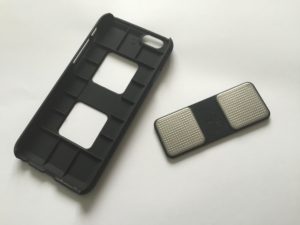
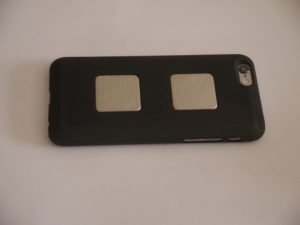
and in use:
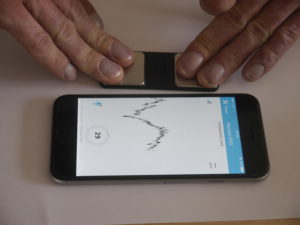
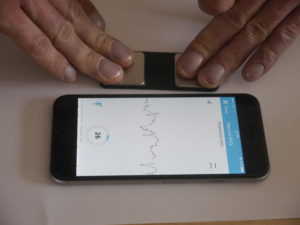
And this is the ECG it took (Actually it’s one it took earlier, in best Blue Peter tradition.)
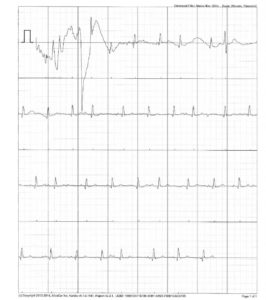
If you fancy your own ECG machine they’re surprisingly cheap (for an ECG machine) at around £100. You can pick one up from Amazon.
Until next time,
Skwerg.