Yeast of Eden

A quest for Low-Salt Bread

An Apology

This time I’m writing about my ongoing quest to find a delicious low-salt loaf of bread. This post is appearing later than I intended because, like any good scientist, I had to do my research and analyse the results before publishing. More about that later, but first a little bit of background.

What’s the deal with Bread?

When I first started looking to cut the salt in my diet, a big shock to me was just how much salt is in a slice of bread. A typical sliced loaf will contain 0.4g or more of salt in each slice. That was a problem as ‘a quick sandwich’ was a big part of my diet covering anything from a meal to a snack. The contribution of bread to sodium levels in normal diets is discussed at length in this article from the Journal of Renal Nutrition. It has an American focus, but we’re not wildly different in the U.K. as this information on the NHS website shows.

I’m not really a half a slice person – more two slices and plenty of filling – so my quick sandwich would use up nearly half my daily ration of salt – more with thick slices – before I’d even put butter on, let alone a filling. If I could make a low salt bread it would really make life easier for me.

Rather than describing a sequential journey of discovery, I’ll write about the various things we have tried. Unsurprisingly, Mrs. Skwerg was chief investigator of recipes. Until recently I just tasted them. There are links to the recipes in the post, or you can find them on the recipes page.

Who Needs Salt anyway?

One of the earliest experiments involved leaving out the salt entirely. We used a recipe from Paul Hollywood’s Book on Bread [1]. That… didn’t work. It turns out salt is quite an important part of the recipe. I mean, who would have known that every one of breads’ four ingredients would be vital…?
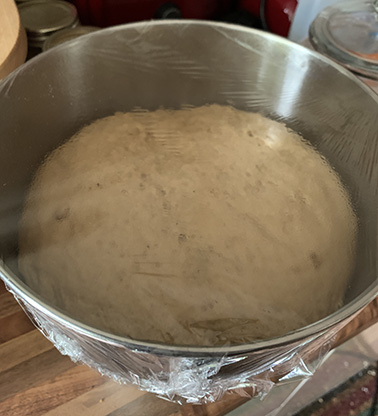
Dough Proving in a bowl

There is a Russian proverb (according to the internet, so…) “Bread and salt never quarrel”. It turns out there’s a reason for all that salt in bread. As it happens the salt isn’t there simply for flavour. As you might imagine, in a food with only four ingredients, each is essential. The Salt interacts with the yeast affecting rise and structure. This fact-sheet from the Federation of Bakers gives a good explanation, including discussion of the industry’s efforts to reduce the salt content of loaves.

Professional Help

We even went to the ‘Bread Lady’, running a stall at our local market asking is she could make a low salt loaf. Unfortunately, despite the excellence of her standard (and other specialist) loaves, we didn’t think the low salt loaf tasted any better than what we could produce at home.

Beer Bread

Casting around for ways to improve the bread we tried another of Paul Hollywood’s recipes – beer bread. We still left out much of the salt, but the beer and honey in it added flavour. That went well, until I found beer contained a fair bit of salt [2].

Nut’s, Chillies and bits of Shrubbery

Following the theme of adding stuff for flavour, we tried a number of different things to give a bit of taste to the bread. Chili flakes, Rosemary, Garlic and Walnuts (Not all in the same loaf I hasten to add!).  We still left out or reduced greatly the amount of salt. By far my favourite was the addition of chilies. Unfortunately, I’m no longer allowed chilies (the reason why is a tale for another post). The bigger problem is that these breads tend to be specialty breads that go well with particular things – cheese, cold cured meats or pizza. As a day-to-day loaf for a bit of jam or honey, they didn’t work so well.

A Literary interlude?
East of Eden book coverIf you recognise the tile as a book, you’d almost be right! It’s a bad pun on John Steinbeck’s ‘East of Eden’ pictured here on the right.


For the musical among you I found this song explaining how to make bread:

I also considered trying to lever ‘toast’ into the title so I could reference this:


Flatbreads

A particularly useful recipe we found was this one for flatbreads.These use no yeast as they are unleavened, so leaving out the salt does not have consequences beyond the flavour.  We use them as one might use a wrap, often with a slightly spicy or strongly flavoured meal like a spiced chicken fajita. The main dish provides the flavouring, and the lack of salt is less noticeable. They are fried which also helps with the flavour and adds calories. They are also very quick to make because they don’t need proving.

Quirky Inspiration

Last year we attended an’ Artisan Bread and Scone Making’ course at the delightful Quirky Workshops in Penrith. Whilst the course didn’t give us a salt free bread, it inspired us to rethink our bread by introducing different sorts of bread such as enriched doughs, challah and sourdough.

Current Loaf
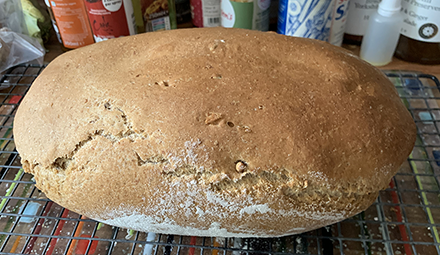
A loaf of home made bread
A loaf of Bread. Home made, low salt and delicious!

I don’t mean current as in fruity, nice though they are. Rather the recipe we currently use for bread. A s suggested in the previous section the workshop got us (Mrs. Skwerg) thinking about a better loaf. After some experimentation we ended up with the one using this recipe. Thanks to the magic of Kenwood mixers I can produce this unaided. It’s also fairly flexible – it can be made into buns or loaves. Initially there were walnuts in it to add a bit of flavour. I’m a fussy so and so though and wasn’t so keen on the bits in it. We dropped them, but the walnut oil and black treacle that are still in there add flavour.

Future Proving
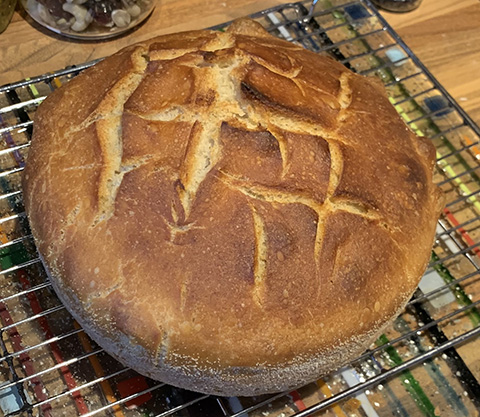
A loaf of Pane Toscano

As part of the preparation for writing this post I investigated low salt bread. Searching around I found this recipe for Pane Toscano, an Italian no-salt loaf that originated from Florentine monopoly on salt making it too expensive for other areas. I decided I should bake a loaf first before I wrote about it – hence the delay due to research. You can see the recipe here on the King Arthur Bakeries website. It’s a complicated loaf, or more accurately it takes a lot of making because it’s a two-stage process the first stage left to prove overnight. The dough is also very sticky and wet making it tricky to work with, however the result was good. The lack of salt left it bland, but when eaten with something salty (Reduced Salt Marmite being a favourite of mine) it’s really doesn’t matter. I’ll definitely bake it again. Andrew Morton in his book ‘Brilliant Bread’, has a pure sourdough version of this recipe [1].

Onwards and Upwards!

My search for a low salt loaf is still ongoing, though the variety of options I have now make it less essential. I doubt I’ll ever find anything to match a nice fresh baked loaf of tiger bread with its high salt content, but that’s not going to stop the experiments!

Until next time,

Wear a mask, keep your distance, and Stay Safe!

Skwerg


[1] For copyright reasons, I can’t give you the recipe, all l I can do is point you to his excellent book.

[2] I spent a good while looking for the article that alerted me to this, with no success. In fact, what I’ve found are many sources suggesting beer is quite low in salt! I’m now wondering if I was mistaken.

Picture This: What you can see from a Lay-by

More than a Medical Condition

This week I’m starting a series of posts[1] that I call ‘Unconditional Loves’. These are posts where I stop moaning about having a heart condition and write about my hobbies. I hope in this way to show that whilst my condition deeply affects my life, it is not the only thing in my life. This time I’m going to talk about my love of Photography.

Why I Enjoy Photography

What is it that I enjoy about photography? Well, there are probably four main things.

Exercise and Fresh Air 

Surprisingly, given my generally sedentary life, the main thing I enjoy about photography is that I go places. I get some fresh air and see nice scenery. My approach to photography is less that I always have a camera on me, and more that I go places to take photographs. The holidays Mrs Skwerg and I go on are invariably based upon going somewhere that will be interesting to photograph. We’re particularly fond of the Lake District and Scotland. Photography is the one instance where my general aversion to hills is mollified. I still don’t go walking over them, but they certainly improve a view.

Taking Pictures

Now taking pictures may sound like a pretty basic requirement for enjoying photography. What I really mean is enjoy the technical skill in taking pictures, understanding how adjustments to the shutter speed, aperture and other controls on the camera (collectively known as the exposure) can change a photograph dramatically. Similarly with the effects of different filters and techniques.

Looking at Pictures

Another apparently obvious one! I enjoy seeing my pictures – particularly the good ones (Our walls host many pictures taken at various times and places)! Even the bad photos can be interesting to look at, working out why they are bad. This does have a downside. Invariably every photograph I look at, I end up assessing against my values of good composition!

Rather than littering this post with my mediocre pictures, if you want to know what I consider some of my better efforts, you can see them here.

People

Finally, I enjoy photography as a group activity. There is something strangely social for what is ostensibly a solo activity when you go somewhere with a group of people or even just one other. Invariably there’s discussions of what is a good picture to take, the best place to be and what settings to use. And of course, the inevitable stop at a tea-shop on the way home! It’s also nice afterwards, comparing the different pictures we’ve all taken from the same place.

A Musical Interlude
You may recognise the title of the post as a song. You’d be right! On the right is the amazing Blondie performing “Picture This”.

It proved difficult to find any photography themed songs that didn’t suggest I was a bit creepy! The best alternative I found is on the right.

Equipped and fully loaded

As you might guess, I don’t tend to use a camera phone for my photography – though I occasionally fall back on it. As my photographic mentor would say, the correct camera to take a picture with is the one you’ve got with you!

Camera Equipment
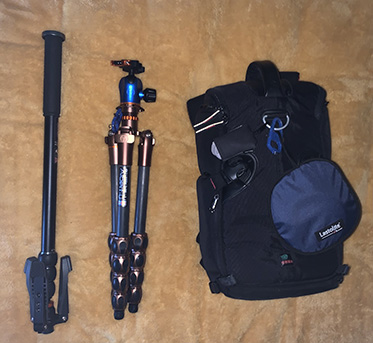
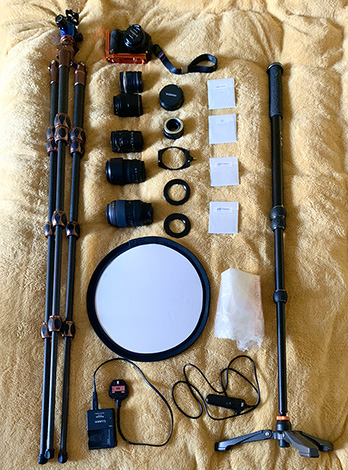
The photography equipment I carry around
My photography equipment Packed down for carrying

The picture to the left shows my full kit spread out – Camera, Lenses, Filters, SD Cards (The digital equivalent of a roll of film. An exceptionally long roll of film) Lens Hood, Light Reflector, Tripod and Monopod. These days you can probably add Bertha to that. On the right is what I manage to pack it down into – a small backpack size camera bag.

Difficulties

Despite this post not being about my condition, discussing its impact on my hobby is unavoidable. Needless to say, the biggest impact is my mobility. I’m not really set up for yomping around the countryside to reach stunning views, especially carrying all my equipment. In the 12 or so years since picking up a camera my mobility has also declined.

Initially this has meant a couple of things. The weight of my equipment is especially important to me. I use a small size camera with an electronic view finder, as it’s considerably lighter than the full-size Canon or Nikon cameras. Similarly, with the accessories – I’m on my third tripod, not because I’ve broken them, but as I seek a strong but light model.

When I began photography, I attended workshops at LPH run by John Gravett. This continued up until last year, when I finally had to admit I couldn’t really manage them. Even though John by the end was tailoring the workshops towards my limitations it was unfair on the other guests that I limit their options

Lakeland Photographic Holidays (or LPH for short) is run by John Gravett, an excellent Photographer with an encyclopaedic knowledge of the Lake District and eyesight that would put a spy satellite to shame. He’s a great guy, and I’ve learned nearly everything I know about photography from him.

It is now harder to find places to go to take photographs. Frankly, the less walking the better. My ideal photographic location is a lay-by with a stunning view. These days a lot of time goes into finding places I can get to in order to take photographs. Bertha has made things slightly easier, giving me a greater range, providing the location is suitable for a mobility scooter.  Unsurprisingly the majority of the best locations aren’t!

It’s possible that at some point in the future I won’t be able to manage photography outdoors. When that day comes, I shall be disappointed but, in the meantime, I hope there are many more lay-byes with a view!

Until next time,

Wear a mask, keep your distance, and Stay Safe!

Skwerg

[1] When I say a series of posts, I mean a set of posts sharing a common theme, but not necessarily sequential posts.

Salt of the Earth

This week I’m going to kick off a series of posts about food, and how my diet affects my condition. I first wrote about this in a post in 2016 titled ‘The Weighting Game’. Things have moved on since then, so a return to the topic seems worthwhile. In the four years since I wrote ‘The Weighting Game’. I have a number of additional food restrictions, which I will discuss in a future Post. Today I want to talk about how my relationship with salt has evolved.

A Quick Recap

Before proceeding, it is worth a quick summary as to why salt is of particular importance to me. Alternatively, you could read the ‘The Weighting Game’).

An aspect of my condition is that I have Congestive Heart Failure. This means I retain fluid – most noticeable as swollen ankles. I take a couple of medications, called diuretics, to help remove the excess fluid. They can only do so much. Salt (or specifically the Sodium in it) is a significant factor in causing fluid retention. It’s why a salty meal will leave you feeling thirsty. To counter this, I aim to eat as little Salt (Sodium) as possible. Most days I consume around 2g of salt or approximately 800mg of Sodium.. This is compared to the NHS recommended daily limit of 6g Salt (2400mg Sodium). According to the National Diet And Nutrition Survey, on average UK Adults consume 8g (4000mg Sodium) per day.

I talk about Salt and Sodium here interchangeably. Sodium is the problem, but Salt is the main way we consume it. I use a conversion rate of 400mg Sodium is equivalent to 1g salt. which I’ve taken from NHS Website (I’ve also seen a figure of 387.6mg Sodium to 1g Salt on the the internet, I believe from the USDA, but if the conversion I use is good enough for the NHS, it’s good enough for me! It also makes the maths easier.).

Keeping to this limit can be quite hard, due to the prevalence of salt in many products – particularly processed foods. In ‘The Weighting Game’ I used the example of an Egg sandwich containing over a gram of salt.

The risk of fluid retention also means I weigh myself every day. I check for (Mrs Skwerg may say obsess over…) changes in my weight that indicate I am carrying excess fluid.

A Musical Interlude
You may recognise the title of the post from a song. You’d be correct: The video below may refresh your memory. It’s the version by Joan Baez.


For the purists among you, here’s the original version from the Rolling Stones.

The Times they are a Changing

So how have things changed in the last four years?

Experience

The major changes in my dealings with salt have come from experience. I have better understanding of how quickly the salt affects. As a result I am better able to assess the consequences of consuming excess salt. More familiarity with the effects of fluid retention has meant I’m better able to identify when I’m retaining fluid.

Swollen ankles aren’t the only signs I get of fluid retention. Lying down redistributes the fluid around the body. Over the day it gravitates down to the ankles. It’s possible to start the day with my ankles looking OK and end the day with them quite swollen.
Often fluid builds in my chest rather than ankles. This gives me a wet cough, reducing my exercise tolerance (how much I can do before I’m breathless). This means I need to keep an eye on things besides swollen ankles or my weight.
Fluid isn’t the only thing that affect one’s weight. There’s no nice way to put this: A few days constipation can lead to similar weight gain as holding fluid. So, plenty of fibre is a must!

I snack far less because am very cautious of taking in a large amount of salt a little at a time. A biscuit may contain only a little salt. If I eat a half-dozen, all of sudden I’ve had half or more of my allowed salt for the day.

Technology

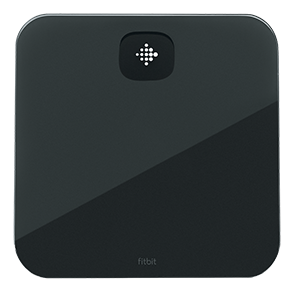
A set of smart scales
Not very interesting to look at, but useful:
Fitbit Aria smart scales.

Technology has also had an effect. I now have smart scales. These send my weight direct to the Apps on my phone I use to monitor my health. It’s a minor thing, but I’m a fan of Technology (As I indicated in this previous post.).

Eggs: contain more Sodium than you'd think
Eggs contain more Sodium than you’d think…

 When I first began tracking my salt, I only really counted salt from processed items. When I began using a diet app to track my sodium and calories it counted the sodium from unprocessed foods. I found I was consuming far more sodium than I had realised. I had never had the data for these foods before and they were not generally considered ‘salty’.  On the back of this, my consumption of eggs has declined somewhat. This is inconvenient when our chickens provide us with an abundance of them!

And relax…

Having said about the additional issues, I think the biggest change is that I am perhaps more relaxed about salt. I know better how the salt affects me, how quickly, and what remedial actions I can take. I am better able to deal with having excess salt occasionally.  This has two impacts.

Firstly, I don’t feel as constrained about eating out. I am less worried that I’m going be ‘the difficult one’ if with friends, constantly vetoing what we eat. Instead I’ll eat just like everyone else, knowing that I will have to deal with the consequences.

Secondly, my daily limit of 2g of salt is not a medically prescribed limit. It is one I’ve arrived at by my own observations of my fluid retention. On this basis I try not to obsess over it. I’ve developed a feel for when I’ve been pushing my tolerances – a combination of weight, breathlessness and instinct. At which point I cut back the salt until things are back under control. Occasionally, I still get it wrong, end up holding fluid, feeling rubbish and need to seek medical advice.

Cooking on Gas

A loaf of home made bread
A loaf of Bread. Home made, low salt and delicious!

I thought I’d finish with a word about home cooking. The simplest way – arguably the only way – to manage a low salt diet is through cooking from scratch.  I am extremely fortunate that Mrs. Skwerg is quite so talented at this. She produces delicious meals with surprisingly little salt in them including curry, risottos, and even pizza. Pizza is still a salty treat. Unlike shop bought or take out pizzas, I can deal with the amount of salt in a home-made one.

I have even improved my cooking skills. I have graduated from being able to heat a ready meal, to baking Bread once or twice a week. I’m even able to slap together a passable tomato-based pasta dish.  It’s my intention to share some of these recipes on this blog in the future.

Until next time,

Wear a mask, keep your distance, and Stay Safe!

Skwerg

I Get Around

In what may seem a bit of a sharp turn, given last week’s post about lockdown and staying at home, this week I’m writing about how I get around when out and about. Specifically, my mobility and Bertha, my Mobility Scooter.

I don’t do hills and I don’t run

I’m not a big walker. I can walk, but not fast, and I get breathless after a short distance. I view hills (and stairs) as the devils’ tools. And I definitely don’t run. I ran about 50 meters for a bus once when I was in my 20’s. Afterwards, I thought I’d need an ambulance. These days, I wait for the next bus.

I’m always self-conscious when walking with other people; I worry that I’m slowing them down. Fortunately, my friends are understanding, and usually stop and wait for me catch up. Overall, it makes going places with people (and even on my own) more stressful than it should be. I’m spending time worrying about keeping up, catching my breath and not slowing everyone down. Time I should be enjoying myself.

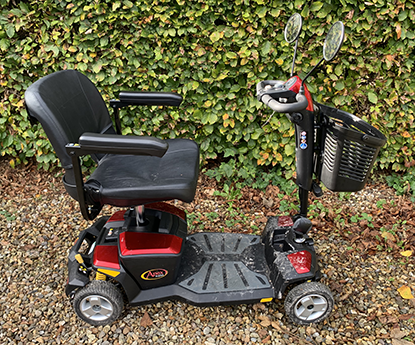
Bertha in all her glory
Bertha in all her glory.

Over the last couple of years (At the suggestion of Mrs Skwerg, of course) I‘ve taken to hiring a mobility scooter when visiting locations such as RHS Gardens, or the local RSPB Sanctuary.  I was able to see and do far more than I would have had I been walking.

I finally borrowed a Scooter from a relative when Mrs. Skwerg and I went away one weekend. It transformed the trip. I was able to get from the hotel, round the Christmas Market (it was November) and back again. I would have been unable to do this had I been walking. It convinced me that I needed a Mobility Scooter of my own.

On returning home, Bertha was purchased.

Options
When buying a scooter (as with many things in life) there are a variety of choices to be made. It’s always worth making a list of ‘Must Haves’ and ‘Nice to Haves’.
When selecting Bertha, the opportunity to borrow one proved invaluable, giving me definite idea of what I wanted. It boiled down to:
– The Scooter had to fit in the Car, without having to modify the car (Many scooters need winches and such to lift them into the car due to their weight).
– It had to be light enough that I could lift it into the car (to retain a level of independence) – or it could be pushed home in the event of problems!
– I wanted wing-mirrors: I found it very disconcerting to have people come past me from behind unexpectedly

Get on your Bike Mobility Scooter and Ride

It’s hard to explain how helpful Bertha has been for me. In some ways, Bertha is really inconvenient. The additional time and effort to bring Bertha makes trips more complicated. Whilst Bertha fits in the car, it means a bunch of other stuff won’t; a trip out involves a family size car but leaves only room for two people and not much luggage. At either end of the journey there’s some effort disassembling and assembling Bertha. And yet, for all the inconvenience, I can do more, and my quality of life is immeasurably increased.

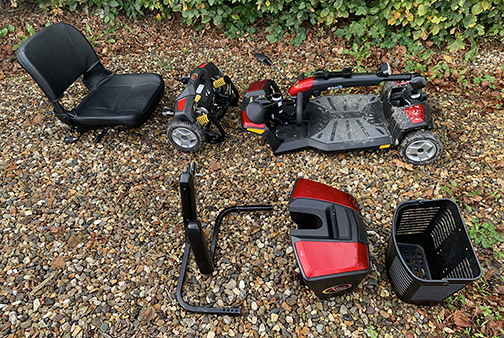
Bertha in Pieces
Bertha in Pieces

It’s the little trips that it means most to me for. Prior to Bertha, a walk to the local shop (Not that that happens currently) was something of an expedition: Now nipping to the shop/post box etc. implies the same quick, minor trip as for other people. Similarly, a jaunt into town to browse round the shops and grab a coffee has become far less tiring and difficult. As I read this back, it seems obvious – of course a powered vehicle is going to be easier than walking! But it is not simply that it is easier. It makes getting around enjoyable for me, instead of the exhausting physical workout of walking.

A Musical Interlude
You may recognise the title of the post from a song. You’d be correct: The video below may refresh your memory.


I had considered using this song as a title, but to be honest, Bertha isn’t that fast…

Parking up and Pedestrians

Using Bertha can be an interesting experience. Travelling around town, I worry that getting off Bertha to go into a shop reflects badly on me. I believe people will think I’m lazy and don’t really need Bertha. I have to remind myself that I do need it, just not in a shop. This article “The Trouble with Mobility Scooters”, from 2012 describes my worries exactly – and is an excellent discussion of attitudes and issues surrounding Mobility Scooters in general.

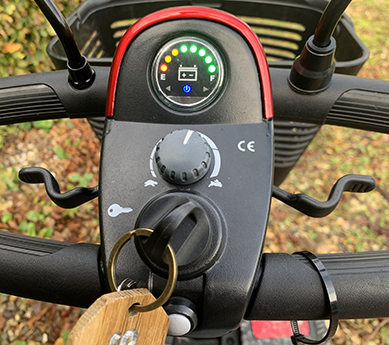
Bertha's control panel
As you can see Bertha can go from Tortoise
all the way up to Rabbit

When driving, a Mobility Scooter has to give way to motor vehicles (I’m not going to argue with that!), cyclists and pedestrians in essence everyone has priority over a mobility scooter. Often there is an apparent lack of awareness of Bertha from pedestrians – probably as Bertha, for the most, part puts one below their eye level. When in a crowd I find this can lead to some last-second maneouvres to avoid people and can be a little nerve-wracking. Just to note; I have no issue with pedestrian’s priority, but the frequent lack of awareness can occasionally be stressful.

Conclusion

As I said earlier I have found Bertha immensely helpful. What I’m most keen on is that I am able to go for days out to places that I might not otherwise be able to, or to see a greater part of them than I would on foot. I’m particularly hoping that my love of photography will be helped by Bertha, taking me (and camera) to places to photograph that I otherwise would not reach. The main difficulty with this is finding places to photograph which are also accessible to Bertha – she needs firm ground and ideally paths, so ranging o’er hill and dale isn’t really on the cards – especially with such things being largely absent from my home region! To this end, I hope future articles will cover Mobility Scooter Friendly (and ideally, photogenic!) places to visit – I’ll categorise them under “Travels with Bertha”.

Also, I hope to fit Wheel Scythes (But I don’t think they’re allowed)

Until next time

Wear a mask, keep your distance, and Stay Safe!

Skwerg.

It’s the end of the world as we know it (and I feel fine)

In case you hadn’t noticed, 2020 has been… unusual.  For the first post of Skwerg’s Blog 2.0, what else could I write about but the pandemic?

A Gut Reaction

COVID-19 absolutely[1] terrifies me. As an illness, it’s scary enough without being near the top of its ‘Easy Pickings’ list. Consequently, I have been Shielding since March. On the advice of Mrs Skwerg, I started Shielding several days before it was officially instigated.

A Cautionary Tale
Hearing about the impact of COVID on my previously healthy and active friend Scott underscored the danger and immediacy of COVID-19 for me. He caught COVID relatively early in the pandemic and ended up hospitalised and on a machine to help him breathe.
I’m sure that what affected him (and is still affecting him) so severely would be a death sentence for me.
Even now six months after recovering, he struggles physically and mentally because of it. Some of what he is experiencing now is familiar to me; dealing with fatigue, good and bad days, and breathlessness.
I’m no way equating my experiences of my condition with the awful and traumatic impact COVID-19 has had on him. It is simply that some aspects seem familiar to me.
I’m glad to say Scott is slowly recovering and has even managed to pick up his paintbrushes again. You can see (and buy!) his excellent paintings for geeks at his Etsy store, Dark Fantasy Paintings.

What has Shielding involved?

Shielding kind of felt like we were splitting up, which I wasn’t really keen on. As Mrs Skwerg was a Key Worker, the house was divided so we wouldn’t be in a room together. I moved into a separate bedroom. Where the room couldn’t be divided, we were never in there together. (I’m happy to say that so far, a house divided can stand!

Then there was the cleaning regime – Mrs Skwerg disinfected everything she used before I could touch it – even the shopping deliveries. Letters and parcels were quarantined for a couple of days before opening. Coming in from work she would decontaminate – disinfect the door, shower, put her clothes in the wash.

Of course I also didn’t leave the house. At least, not beyond boundaries of the garden. I also stopped answering the door – we put a big sign up politely asking people to leave their deliveries and then go away.

Things relaxed a bit as the first wave passed. I even left the house a few times; several for medical reasons, and twice for pleasure; going to areas with few people in order to take some photographs.

With the swelling of the second wave we’re returning to our more rigorous routines. I’m firmly back in the house, and evenings of watching TV whilst socially distanced are again on hold.

So how has Shielding affected me?

Mental Health

According to some pundit’s I should be suffering mental health issues from my isolation. I’m fortunate to be able to say I don’t think I’ve had any particular malaise of the mind. Of course, some may suggest my new beard and hairstyle gives lie to that.

Perhaps my normal fairly sedentary daily routine has helped – it didn’t change much with lockdown. In fact, I think my initial response to Shielding was along the lines of “Stay in my room for six months? May I have my computer in there with me? Yes? Great!!”. A few days later Mrs Skwerg insisted I actually got dressed and used a bit more of the house. I was terribly disappointed.

A more insidious impact has been a level of anxiety, I think. I never picked it up myself – as ever the amazing Mrs Skwerg did, relating it to the difficulty I was having sleeping. That seems to have improved thanks to better sleep hygiene on my part.

Is your sleep hygienic?
Sleep Hygiene is about having a routine and an environment conducive to good sleep. Read more:
– on the NHS website
– or in this Pamphlet from from the Wrightington, Wigan and Leigh NHS Trust.

Physical Health

The biggest impact has probably been on my physical health. I’m not the most active person, and what little exercise I was doing was curtailed. For a while I took regular (short) walks round the garden. After a couple of weeks my knee swelled up like a beach ball and I stopped. I now find I’m more fatigued and have a lower exercise tolerance than I have in a long while. I’ve begun walking the garden again recently; but I can only manage a very short distance and it leaves me breathless and needing to sit and recover.

Healthcare

My normal interactions with health professionals have had to change. The regular visits to the GP, Pharmacy and Hospitals have not been safe to undertake. The NHS rose to the challenge. The systems and changes they have put in place have been excellent. My GP has done Home visits as have other local Healthcare Professionals. GP and Hospital appointments have been replaced with telephone and recently, video appointments. Certainly, I’ve found them just as good as being seen in person. My weekly trip to the pharmacy (I have lot of medications) has been replaced with the introduction of a home delivery service.

A Musical Interlude
You may recognise the title of the post from a song. You’d be correct: The video below may refresh your memory.


I briefly considered the song in the video below as an alternative title, but felt it was perhaps a little too metal to be widely recognised…

Keeping in Touch

I’m not one for partying the night away these days but as many do, I enjoy the company of friends and like to talk to see my family occasionally. A major Hobby of mine is fundamentally social in nature – I play Table-Top Role-Playing Games.

In this respect modernity has come to the rescue. Skype has proved invaluable for keeping in contact with people (even recontacting a friend from 30 years ago!) and for continuing to participate in my hobby.

Conclusions

I am sure that my experiences described here are familiar to millions around the country. There’s nothing particularly special about my situation except that I’ve been lucky.

I’ve been lucky to have Mrs Skwerg’s excellent advice and steely determination to keep me on this mortal coil.

I’ve been lucky that my condition has proved fairly stable for perhaps the longest period in nearly five years, enabling me to stay away from hospital.

I’m lucky that I’m retired and don’t have an obligation to an employer or customers forcing me to come out of hiding and go to work.

I’m lucky that I’m happy sat on my own faffing on a computer.

And I’m crossing my fingers that I’ll be lucky during the next wave too.

Until next time,

Wear a mask, keep your distance and keep safe.

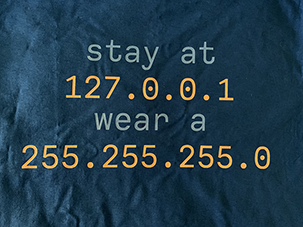
For the nerds among you:

stay at 127.0.0.1 wear a 255.255.255.0
Sound Techie Advice

Skwerg.


1. ‘Absolutely’ wasn’t the word that I used initially, but I thought I’d try to keep it PG for at least one post.

Skwerg’s Blog is Dead! Long Live Skwerg’s Blog!

I come to bury Skwerg’s Blog, not to praise it.

I’m rebooting the blog.

It has been some time since I last posted anything meaningful on my blog. Three years in fact.  I think that’s enough time to know it’s dead. All that’s left is the autopsy.

Well, frankly, I didn’t post any articles. That pretty much covers it. Nobody’s fault but mine.

Skwerg’s Blog is no longer with us.

It lives!!!

The thing is… I enjoyed writing those articles. I feel I’ve more in me to write. The current times of COVID-19 and the lockdown are a bountiful source of material for writing about living with my condition. Add in various health issues, and the many changes that have occurred in the last three years, I should have plenty of posts to write.

In light of this I’m rebooting Skwerg’s Blog as Skwerg’s Blog 2.0. As with all that rises from the grave it will have undergone a few changes.

A quick analysis

  • The major reason I didn’t post articles was that I felt I was straying beyond what I was qualified to talk about. I was trying to explain my condition and how the NHS worked. I’m no clinician, and don’t want to be stating things I’m unqualified to say, whether or not they’re correct. That is the job of the highly trained professional experts called Doctors and Nurses (and Pharmacists, Radiologists, Biomedical Scientists and all the many other disciplines in the Clinical sphere.).
  • My posts were awfully long. I found it hard to write that many words frequently enough.

The way forward…

In the light of this Skwerg’s Blog 2.0 will have shorter articles. I will try to focus on my experience of living with my condition, rather than the clinical aspects of it. Where necessary I’ll still write the technical stuff, but the overall aim is to write about my experience.

I’m also taking the opportunity to reorganise the Blog. You’ll still see a chronological list of posts, but each post will have a category:

  • Meta Posts – these are posts about the blog itself – such as this one.
  • Conditional Expressions – these are posts about my Condition and living with it.
  • Travels with Bertha – these posts will talk about places I’ve been with my mobility scooter (named Bertha) and hopefully suggest places people with mobility issues can visit and enjoy.
  • Salty Talk– posts about my diet and managing the restrictions I have, including hopefully delicious recipes which, if not healthy at least keep your sodium intake down a bit.
  • Unconditional Loves– these posts will be about what make me a person, rather than simply an interesting condition – my hobbies and such.
  • Old Posts – Finally you will still be able to find my original Skwerg’s Blog 1.0 posts here – I still believe they’re good reading and I am proud of them, so I still want them available to readers.

In the spirit of Skwerg’s Blog 2.0’s new, shorter posts,

Until Next Time, Skwerg.