
First Posted 17th June 2016
Last weekend I had a McDonald’s breakfast (a Double Sausage & Egg McMuffin meal and an extra Hash Brown, in case you were wondering). That may not seem any great news, but I’ve not had one for a long time now and I love a McDonalds Breakfast.

The immediate cause of my orgy was because my weight had dropped to under 62 kilograms. This may illicit the questions “why are you trying to lose weight?” and “is a meal packed full of grease and processed meat really the appropriate way to mark the occasion? Surely a lettuce leaf would suffice?”.
All valid questions, however I’m not trying to lose weight particularly. I have never been a particularly heavy person by any measure. I think “scrawny” may be the right description – all elbows and ribs. Weight loss has never been the primary goal of my dietary shenanigans, though a slight obsessive nature may have made it more prominent than strictly required.
What I’m getting at is I wasn’t trying to lose weight as you might if you had a few too many chocolates over Easter. In fact, I’m at a healthy (just) weight for my height according to this NHS chart. I watch my weight not to lose it, but rather to maintain it, and have done ever since I went into Congestive Heart Failure in August 2013.
I’m going to talk more about my experiences around that time in a future post, but for now, it’s sufficient to say it was a life changing event and I came out of it taking diuretics. The diuretics are to stop me retaining fluid, which is both a sign of, and exacerbates, Heart Failure. With fluid retention comes, rather unsurprisingly, weight gain. I use the deeply untechnical term “Swelling up and Dying” to describe this. By monitoring changes in my weight and checking for ankle swelling one can get an early warning of the onset of heart failure. Appropriate action can then be taken and a repeat of my 2013 trip to hospital avoided.
So every day I weigh myself.
I use the same set of scales to ensure I get a consistent measurement because without being properly calibrated any two set of scales are likely to be reading different weights. I also take my weight unclothed (It’s OK, I won’t add pictures!) I also aim to weigh myself at the same general time each day – not so much clock time, though it tends towards that but rather what I think of as biorhythm time. i.e. I weigh myself after waking up and before I eat or drink. Fortunately for me, I’m not that interested in the exact numbers, just the amount they change day to day so providing I stick with the same set of scales, I should be good.
The weighing can get a bit more difficult if I go away, especially for extended periods (and on a ship it gets really tricky!) For the most part on those occasions I just skip the day’s weigh-in and rely on other indicators (whether I can get my socks over my ankles for example…) as to whether I am heading towards problems.
The weighing is all well and good, and produces a lovely graph (when you don’t lose all the data updating your phone, as I did a week ago…) but it is just monitoring. The real work goes into controlling the weight in the first place.
When I began taking the diuretics back in December 2013, I began to notice that certain foods seemed to cause my weight to go up quite rapidly in conjunction with water retention (I hadn’t simply been eating ALL the pies, as is my wont). It was pretty clear that the common factor was salt.
Excessive quantities of salt have long been known to be bad for the heart, however some salt is vital for good health. An adults GDA of salt is 6g. My diet at the time was fairly heavy on the salt (I never added any to my food but my food choices were, to say the least, poor in that respect).
While the medical professionals I see didn’t instruct me to reduce my salt intake, I began to reduce the salt in my diet. In fact, I aimed to eat a low salt diet, keeping to around 2g of salt a day. It has been seen as a generally prudent move by the aforementioned professionals. I don’t always – probably don’t often – manage to keep to that little, however I have certainly reduced my salt intake by (I reckon) at least half. Over the last couple of years, my diet has changed, and I’ve made a few discoveries.
The first discovery was just how much salt there is in the food we buy. Sure, there are some obvious foods to avoid – Bacon and Cheese (I love bacon and cheese!) but there are many unlikely containers of Salt – and not just there’s a bit of salt but amounts that seem designed to make keeping to the GDA, let alone a 2g limit almost impossible. For example, a slice of bread typically contains around 0.4g of salt. A quick sandwich (2 slices of bread with something in between) or a couple of slices of toast (even without Marmite, which I rather like) is for me almost half my day’s salt intake. Similarly, a 125g pot yoghurt contains around 0.2g. And it’s not just foods. Many fizzy drinks (Typically – and you may spot a theme developing here – the ones I drink by preference) contain 0.1-0.2g per 100ml. Distressingly, beer can be quite salty too, with a can containing between 0.3g and 0.5g. Chocolate contains 0.2g per 100g. I have not investigated the salt in Scotch Whisky!
What I’m trying to show here, is the prevalence of salt in almost all the food we buy. Much of this is down to salt being a good preservative, and a fair portion is that it an important element in the taste of many things (Our early experiments in making salt free bread produced quite distressing results! Though we found the answer was to add alcohol.). The upshot of this it’s much harder for me to ‘snack’ the way I used to when I’m out of the house. Many premade foods are high in salt. In the past I’d think nothing of having a sandwich with my coffee in Costa Coffee for breakfast, or a pack of premade sandwiches, or a Sausage Roll if I were peckish. Alas no more. Whilst the high salt content is by and large down to the combination of ingredients in the item, I can’t help feeling that an egg & cress sandwich shouldn’t need to have over a gram of salt in it.
I’ve also discovered there are foods that I just have to avoid. I suppose that’s less a discovery and more a logical conclusion of watching my salt. Take away Pizza stopped when I found it had about 8g of salt in it. McDonalds when I looked up the nutritional information. Recently I felt I needed to stop having Chinese takeaway after a day of weight gain, tiredness and general sluggishness following one. Most recently I’ve decided to stop drinking Latte Coffees as I’ve found milk has a surprisingly high salt content (0.1g per 100g according to Wikipedia – and indeed the label on the carton in my fridge). Unfortunately for me there is a very high correlation between salt content and food I like to eat…
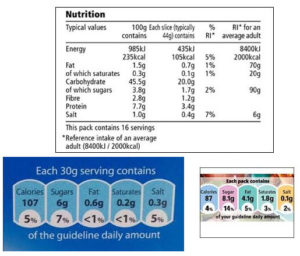
An important learning point was how nutritional labelling on food can be not actually inaccurate, but rather be somewhat obfuscating. I have developed the habit (obsession) of always reading the nutritional information label on a packet – partly because of the unexpected salt in food discussed above, but mainly so I can keep a running total of my salt intake.
Whist the labels are informative one has to check carefully what the information relates to. Rarely will a pizza tell you how much salt is in the whole pizza but rather ‘per slice’ or ‘half a pizza’. Sweets will be ‘per X sweets’. Fortunately, the values per 100g are nearly always available too, allowing a level of comparison. The danger is – for me at least – I don’t eat half a pizza, or 7 sweets, or one third of a pie – I tend to eat the lot.
I realise that I’ve just written several paragraphs of what might be termed whining. I’m very aware that compared to many others – diabetics, coeliacs and lactose-intolerant persons, I really don’t have much to complain about. I’m not even particularly hard done by in the salt realm – I know of one person who is unable to process any salt. In fact, when I look at it, much that is positive has come out of reducing my salt.
Obviously, not ‘Swelling up and Dying’ is a major bonus.
I probably eat much more healthily now. Simply by the necessity of cutting out much of the processed foods and takeaways, my diet has become better. As part of that I’ve discovered many things I like that I previously never really tried. Spinach for example, Quiche (but not of the Lorraine variety). Sure there’s still cheese in our cooking, but less of it. I’ve learnt to make (after a fashion) bread. I’ve tried making hummus (I need to give that another attempt). We make our own pizzas – still a treat with a big dose of my daily salt in it but better that any takeout one. We make our own Curry too – The purchase of a couple of cookery books and many spices has introduced a world of new flavours, and with far less salt. I’ve explored new flavours – I’ve moved from not eating particularly spicy food to actually seeing chilli as a flavouring to add taste to all sorts of things (I’m still not going to have a vindaloo though). Anyone who has eaten my cooking will realise I am not the culinary genius creating all these dishes. The credit there goes to my wife (Although a satisfactory low salt sausage recipe continues to elude her!).
Having reduced my salt intake, I notice it’s presence much more in other foods when I do eat out, often wondering why so much is needed (answer: we – the population – have become desensitised to its presence in our food).
The main thing I’ve learnt is that, like many things in life, managing my salt is about consequences. Having 6g of salt one day isn’t actually a problem but I have to accept that if I do that, I will retain fluid and over the next few days will need to manage that. So when I say I can’t eat something what I mean is the consequences are more than I am happy to deal with, but that doesn’t prevent me from eating them if I am happy to accept those consequences. Hence the McDonalds breakfast. I was happy that with my weight that low, I would be relatively unaffected by the extra fluid the salt may cause me to retain. Equally there are times that I just can’t manage my salt intake as effectively – usually if I am visiting friends or on holiday. At that point I have to rely on a combination of my growing knowledge of what is relatively salty, close monitoring of my ankles and my weight, and accepting that I may need a period of extreme desalination when it’s over to fix me..
I’m looking forward to my next McDonalds breakfast, but it won’t be for a while, and in the meantime, I’m afraid I’m going to be a fussy eater.
Until next time,
Skwerg.
Addendum
When I began this blog I was thinking of making the low salt aspect a significant part of the site. I wanted to be an information hub on salt in foods, with a searchable database of the salt content of various foods. I also planned a page with recipes that were either zero salt or tweaked to minimize the salt.
Since researching this post my initial plans are evolving. There is actually much more information out there on salt than I had thought, so I’m going to start by providing a page with links to various resources I’ve found. The recipes will stay and I’ll aim to put the first one up soon. I still want to do the database but I need to think about exactly what it will contain.
Skwerg.